How Family Offices Survive the AI Era
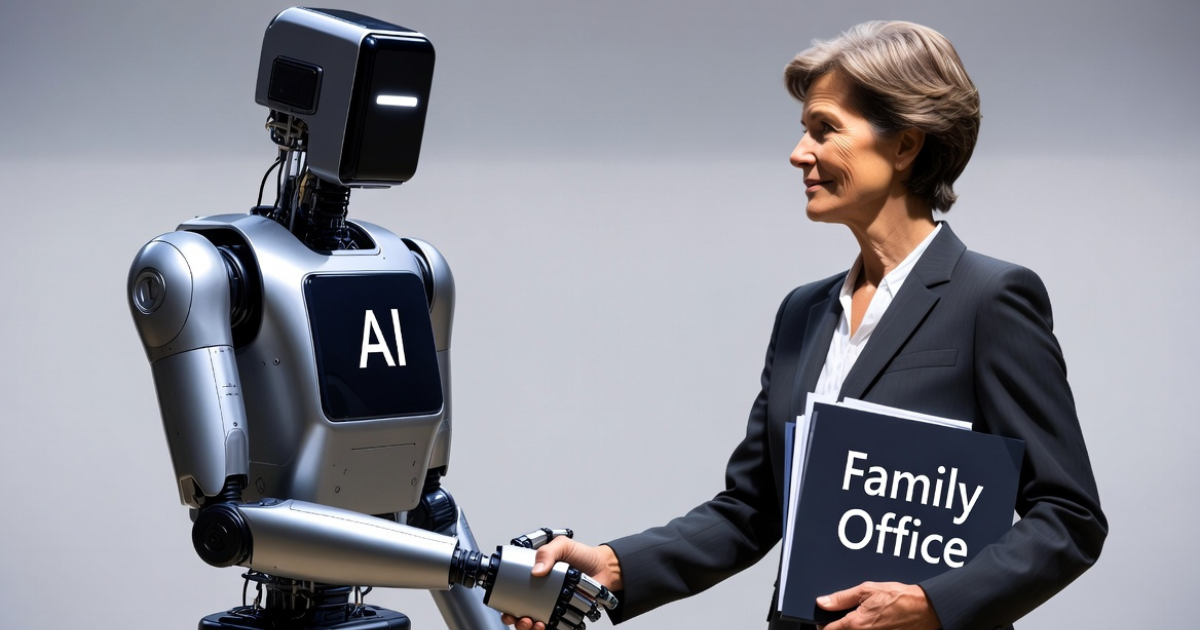
Family offices can survive and thrive in the artificial intelligence era
There’s a storm on the horizon. Let’s examine AI and the future of your job, the nightmare scenario that folks in the family office and wealth management industries desperately want to avoid.
You wake up one morning, and the skills you’ve built your career on, your ability to analyze, package, and deliver advice, have been productized by an AI tool that is faster, cheaper, and “good enough.” Overnight, you’ve gone from prestigious and indispensable to an expense line with a question mark next to it.
Look, I understand the fear. In early February 2026, when an AI tool from Altruist claimed it could generate personalized tax strategies by reading client documents, the market responded as if the disruption had already arrived, hammering wealth management and financial services stocks.
When the (justified) panic jumped across the Atlantic, hitting firms like St. James’s Place and spilling into broader European wealth management, it wasn’t because investors suddenly became technologists; rather, the value proposition of many advisory businesses still sounds like “we produce plans,” and AI can produce plans faster, cheaper, and without needing a corner office.
If you’re a family office leader or a senior wealth manager, it’s tempting to respond with a tech arms race: build more tools, add more dashboards, hire the AI strategist, and hope the client can’t tell the difference between “human advice” and “AI-assisted advice.” That may help on the margin, but it does not solve your existential problem.
Fundamentally, advisors sell the idea that their value is crunching the numbers and producing the plan.
Well, AI is beginning to produce the plan. Now what?
Lifestyle Design
You sell something AI cannot produce: a deeply human relationship that improves the client’s life in ways that transcend money.
Here’s what you need to understand. Clients don’t care about money for money’s sake. They want to be healthy enough to enjoy their lives. They want their families to function. They want their time back. They want to feel alive again. They want to know what they are doing all of this for. They want to be happy and secure.
That, my friends, is lifestyle design.
Lifestyle design is the intentional construction of a life that is enjoyable, meaningful, and sustainable, rather than a default life that is wealthy, busy, and strangely hollow. It includes purpose, fun, adventure, relationships, and the deliberate use of money to buy time, reduce friction, and expand options rather than to accumulate as a sport.
Go ahead, start with a clean sheet of paper, and consider all the services you can offer. Help with travel. Encourage meaningful social connections. Plan family reunions. Set up dinner dates. Become a one-stop shop for all your family’s needs, and you are indispensable.

Affluent principals care about lifestyle and longevity
Longevity 2.0
Longevity is in. The pandemic shattered our illusions of security and made our vulnerabilities clear. All of us, including your principals, want longer, healthier lives.
The trouble with concierge longevity is that it is a cesspool of shady personalities and self-promoting celebrity “influencers.” Smooth-talking snake oil salesmen hawk unproven pills and potions that they promise will add decades to your life as long as you keep sending them checks for their proprietary formulas.
Many pop physicians, such as the now-disgraced Dr. Peter Attia, face ethical questions and a lack of formal training. These folks, while smart and polished, are all hat and no cattle. Hype without actionable substance. Your job, as a holistic family office or wealth manager, is to bring trustworthy doctors into the fold to deliver humanistic, proven solutions your principals want.
I wrote about that dynamic recently, using Dr. Peter Attia’s implosion as a cultural signal that the longevity influencer era is unstable and that the future of concierge longevity care must become more grounded, more pragmatic, and less performative.
That future is what I call Longevity 2.0.
Longevity 2.0 is not about exotic stacks, expensive “optimization” tests, or unproven pills, potions, and risky interventions. It’s about what works, and what works has been embarrassingly consistent for decades: personalized nutrition that people can actually follow, deep sleep protected like an asset, meaningful relationships with family and non-transactional friends, and regular exercise that includes both cardio and strength.
That’s not sexy, but it gets the job done.
Because the biggest problem in health is not information, it's implementation.
And implementation is where family offices and elite wealth managers can become indispensable in the AI era. AI can produce content, but it cannot produce accountability, coordination, and humanistic trust across a principal’s messy real life.
When advisors and family offices become more holistic, focusing on lifestyle design and Longevity 2.0 alongside capital, they become less replaceable. The holistic family office is something AI can never be: human.
So the strategy is not to “compete with AI” by looking more like a machine.
Compete with AI by doubling down on the parts of your work that are least automatable: relationships, judgment, coordination, and care for the whole person behind the balance sheet. Heck, you might even enjoy working with AI, once you view it as a tool for your humanistic approach rather than as a potential adversary.
Become the kind of advisor your principals can’t imagine living without.
(And if you’re thinking, “this feels more like a philosophy than a product,” good—that means it’s harder for AI to copy.)
Gregory Charlop, MD, is the premier fractional Chief Wellness Officer (CWO) and concierge longevity doctor for elite families. He's a keynote speaker at the Barron's Advisor 100 Summit and a member of the Barron's Hall of Fame. He helps family offices and financial executives build healthier futures for their clients through modern lifestyle design and holistic care. Regularly featured on ABC, NBC, FOX, and Forbes, Dr. Charlop is a Georgia-based, Stanford-trained physician, popular conference speaker, and author of four books. He provides bespoke lifestyle medicine services to select individuals in Atlanta and across the USA.